Surfaces Built to Handle Daily Business Traffic
Commercial Concrete in Tyler for properties requiring durable parking areas, sidewalks, and storm-ready drainage systems
Tyler's commercial properties face specific wear patterns that residential concrete never encounters. Dollar Concrete handles commercial concrete installation and repair for parking lots, sidewalks, city approaches, curbs, gutters, and driveways designed to withstand constant vehicle weight and pedestrian traffic. Whether a parking lot shows cracking from repeated freeze-thaw cycles or curbs need replacement after storm damage, the work focuses on materials and methods that match commercial load requirements rather than residential-grade solutions.
Commercial concrete projects require different thickness specifications, reinforcement schedules, and curing protocols than residential work. A commercial driveway supporting delivery trucks needs deeper aggregate base and higher PSI ratings than a home driveway, while sidewalk approaches must meet ADA slope requirements and city engineering standards for pedestrian access. The concrete mix itself changes based on whether the surface will handle foot traffic only or repeated forklift loads.
Request a site evaluation to determine thickness requirements and reinforcement specifications for your commercial property.
What Proper Commercial Installation Requires
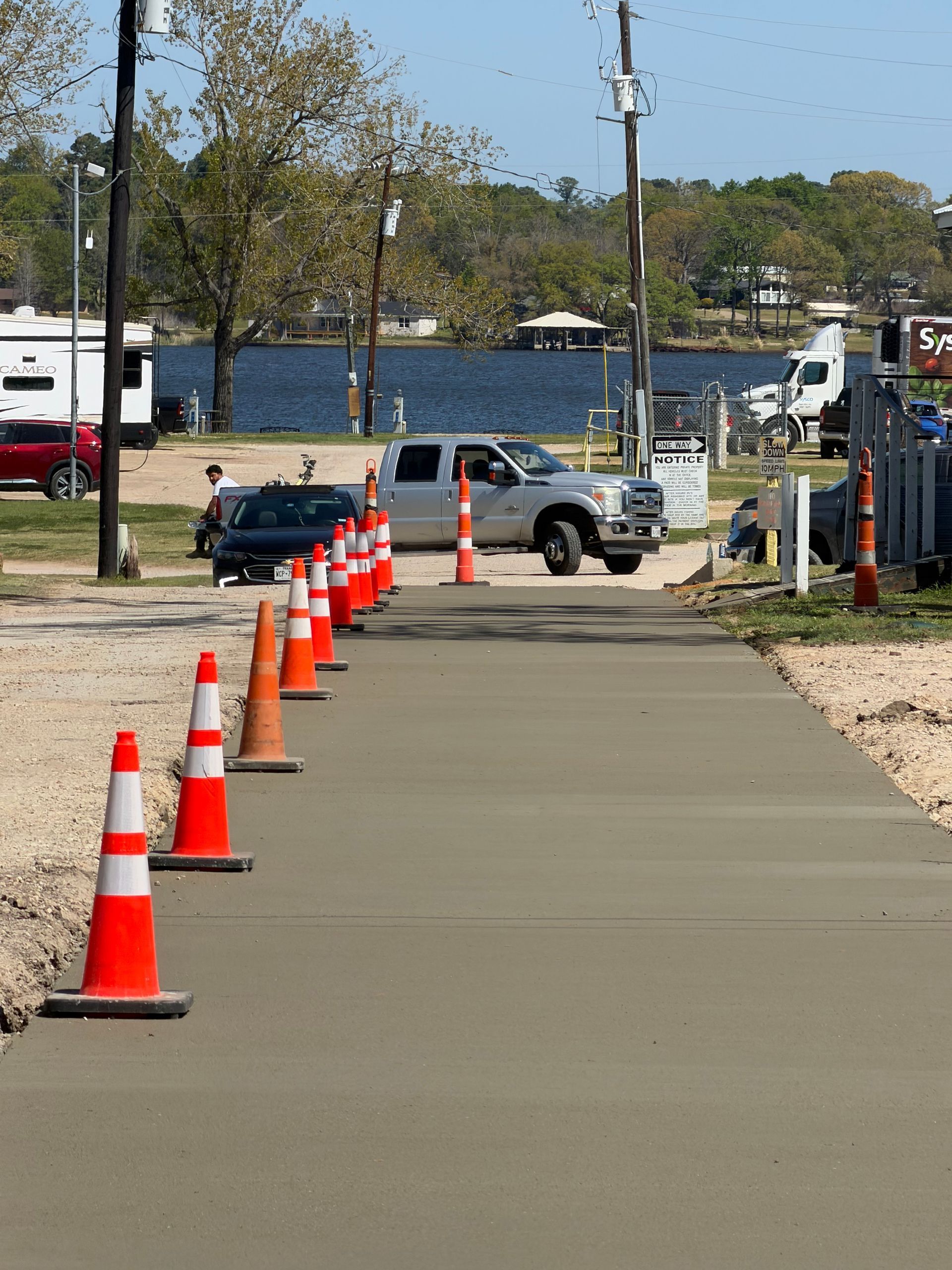
Commercial concrete installation begins with verifying the existing base can support projected loads without settling. For parking lot repairs, this means removing failed sections down to stable subgrade, compacting aggregate base in lifts, and installing rebar or wire mesh based on traffic patterns. Curb and gutter work requires forming to match street grade and ensuring proper drainage slope so water moves away from building foundations rather than pooling against commercial structures.
Once commercial concrete cures and finishing work completes, you'll notice surfaces remain level under truck traffic, water drains predictably during storms, and edges hold their shape where vehicles enter and exit. Properly installed commercial concrete eliminates the rutting and edge failure that creates liability concerns and requires constant patching. Sidewalks stay even without trip hazards forming at panel joints, and parking areas handle delivery schedules without showing premature cracking from weight stress.
Commercial projects also involve coordinating with business operations to minimize disruption. Concrete removal generates noise and dust that affects neighboring tenants, while curing time determines when areas reopen to traffic. Phasing the work across multiple pours allows portions of a parking lot to remain functional while others cure, and scheduling concrete removal during off-hours reduces the impact on daily operations.
Questions Before Starting Your Commercial Project
Commercial concrete projects often raise questions about load capacity, timing, and compliance standards. Understanding what the work involves helps property managers and business owners plan around construction schedules and budget for the appropriate level of durability.
What thickness does commercial concrete require?
Commercial driveways and parking areas typically require six to eight inches of concrete over compacted aggregate base, compared to four inches for residential driveways, because the surface must support delivery trucks and repeated heavy loads without cracking under weight stress.
How do curb and gutter installations prevent water damage?
Curbs channel stormwater into gutters that direct flow away from building foundations and toward drainage systems, preventing pooling that undermines pavement edges and creates erosion around commercial structures during Tyler's heavy rain events.
When should concrete removal happen before new installation?
Concrete removal becomes necessary when existing slabs show structural failure such as widespread cracking, settling that creates drainage problems, or surface spalling that exposes aggregate, since pouring over failed concrete transfers those problems to the new surface.
What determines whether a parking lot needs full replacement or sectional repairs?
The decision depends on how much of the lot shows distress; if cracking and settling affect less than thirty percent of the surface, targeted repairs extend serviceability, but widespread failure across most panels makes full replacement more cost-effective than continuous patching.
How do city approach specifications differ from standard driveway work?
City approaches must match municipal grade requirements and tie into existing curb cuts at specific angles, ensuring smooth transitions that meet engineering standards for public right-of-way access rather than following property owner preferences.
Dollar Concrete provides commercial concrete services designed for business property demands, from parking lot repairs that handle daily traffic to sidewalk installations that meet accessibility standards. Schedule a property assessment to review your commercial concrete needs and determine the appropriate approach for your facility's traffic patterns.